
Blackbeard 1680?-1718
Pirate and Proud of It
Blackbeard’s early life is shrouded in mystery. Academics
argue over his birth place, birth date and even his original name, which
has at least three variations: Edward Teach, Edward Thatch or even Edward
Drummond. In Bristol his memory is a mixture of both denial and
proud son but, despite this, local legend persists that he was born in
Redcliffe.
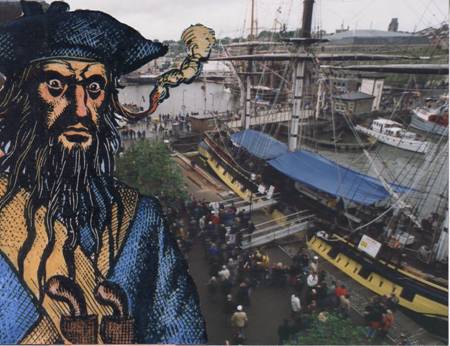
Blackbeard casting his fearful eyes over Bristol’s hugely successful
‘Festival of the Sea’ in 1996.
What is known isn’t very savoury. He was thought to have
14 wives, but how many were “port wives” isn’t clear. He
served with Benjamin Hornigold and was given command of one of his prizes,
a French slave ship named La Concorde which he renamed Queen Anne’s
Revenge (some pirates had Jacobite sympathies). He made the Bahamas
his home during its “Pirate Republic” heyday, two years prior
to Woodes Rogers’ arrival. {Woodes Rogers’ first task as Royal
Governor was to clear out the nest of pirates]
Captain Johnson enjoyed describing Blackbeard, and the following description
originates in his “General History …”.
Decency
prevents me from using the anecdote regarding the pirate’s last
wife, a fifteen year old plantation owner’s daughter.
“Teach, the most colourful and well-known of all the pirates is
a never dying legend. He was a massive man noted for his boldness,
fiendish appearance and roguish ways. With cutlasses and three
brace of pistols slung about him, he resembled a walking arsenal. His
long black beard was twisted with brightly coloured ribbons and turned
about his ears. Slow burning fuses (or matches) tucked under his
hat wreathed his head with demonic smoke. All this, together with
his fierce and wild eyes made him such a figure that imagination cannot
form an idea of a fury from hell to look more frightful.”

A rare, 1724, image of Blackbeard from Capt. Johnson’s book, note the infamous
‘3 brace of pistols’ and their early design (no proper handles).
One day at sea he said to a few of his men, “come, let us make a hell of our own, and try how
long we can bear it.” He took them below, closed up the
hatches and set on fire several pots filled with brimstone and other
acrid matter. One by one, close to suffocation, the men were
forced to seek the upper deck. Blackbeard held out the longest
and was quite pleased that he was better fitted to live in hell than
the others.
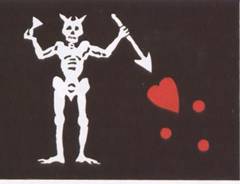
Blackbeard’s Jolly Roger – a death figure with devils’ horns, an hour glass (with time running out), and a pierced heart.
On another cruise in the early 1700s Blackbeard punished a mutinous crew by marooning them on Dead Man’s Chest, a small remote island in the British Virgin Islands chain, without water or landing places. Each was given a cutlass and a bottle of rum and Teach’s hope was that they would kill each other, but when he returned at the end of 30 days he found that 15 had survived.
This would explain in full the verse:
Fifteen men on the dead man’s chest,
Yo ho ho ho, and a bottle of rum!
Drink and the devil had done for the rest,
Yo ho ho ho, and a bottle of rum!
This of course was immortalised in Stevenson’s Treasure Island.
At the edge of the township in the Bahamas, Blackbeard held his court
under a wild fig tree. He used to sit in council amongst his
banditti, concerting or promulgating and exercising the authority of
a magistrate. It is said that under the tree he kept a barrel
of rum from which all who passed by were invited to drink. Those
who hesitated were given a choice of drinking or being shot. Amazingly
several wild fig trees grow today in Bristol, one of which is opposite
the old Georges Brewery in Castle Park (actually growing out of the
river wall).

Blackbeard holding court.
Hornigold took Rogers’ pardon in 1718, but Blackbeard carried on his reign of terror in Virginia. There, with his ship’s master Israel Hands, they caused havoc all around: one of their more notorious acts was to blockade harbours for days on end to obtain goods and ransom money. In the end Governor Spottiswood brought in the Royal Navy to finish Blackbeard off.
Immediately prior to this, Israel and Blackbeard’s pilot, Marshall, were drinking together, and without provocation Teach drew out a pair of pistols and cocked them under the table. When he was ready, he crossed them and fired. Hands was shot through the knee and so missed the last engagement. When asked why he had done this, Teach said, “Damn you all! Unless I now and then kill one of my men, they will forget who I am”.
The man sent by the Royal Navy to terminate Blackbeard’s career
was Lieutenant Robert Maynard in his sloop the Pearl, and on 22nd November
1718 Maynard tricked him into battle off Ocracoke. After a savage
encounter, in which he sustained over 20 cuts and at least 5 shots,
he was killed and decapitated. His headless body was thrown overboard
and allegedly swam round his ship 3 times before disappearing. Of Maynard’s
men, 10 were killed and 24 were wounded.
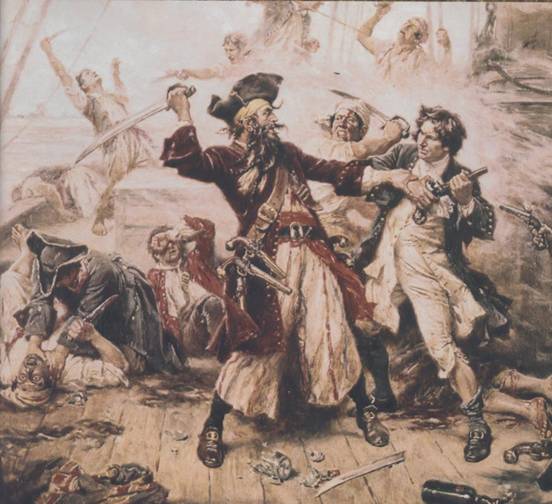
Fight to the death – one of Maynard’s men saves him in the nick of time.
As was the custom with a pirate, his head was hung from the bowsprit, and the skull ended up as a drinking vessel in a tavern in Williamsburg. The authorities caught up with Hands and would have hanged him as well had he not been reprieved at the last minute by a proclamation prolonging the pirates’ pardon. He finished his days in London a poor lame beggar.
According to Captain Johnson, here are the names of the pirates killed
in the engagement:-
| Edward Teach, commander | Philip Morton, gunner |
| Garret Gibbens, boatswain | Owen Roberts, carpenter |
| Thomas Miller, quartermaster | John Husk |
| Joseph Curtice | Joseph Brookes (1) |
| Nathaniel Jackson |
All the rest, except the two last, were wounded and afterwards hanged in Virginia.
| John Carnes | Joseph Brooks (2) |
| James Blake | John Gills |
| Thomas Gates | James White |
| Richard Stiles | Caesar |
| Joseph Philips | James Robbins |
| John Martin | Edward Salter |
| Stephen Daniel | Richard Greensail |
| Samuel Odel, acquitted | Israel Hands, pardoned |
The prize for Maynard’s brave men who risked life and limb was £2,500 divided equally amongst the companies of his two ships, the Lime and the Pearl. The money was the proceeds of Blackbeard’s ‘Treasure’ – 25 hogsheads of sugar, 11 tierces, 145 bags of cocoa, a barrel of Indigo, and a bale of cotton, along with the sale of Blackbeard’s sloop and monies from the Governor and his Secretary (pursuant to their proclamation).
There have been calls for a statue of Blackbeard in his home town, but some have said that a cycle path named in his honour might be more appropriate.